
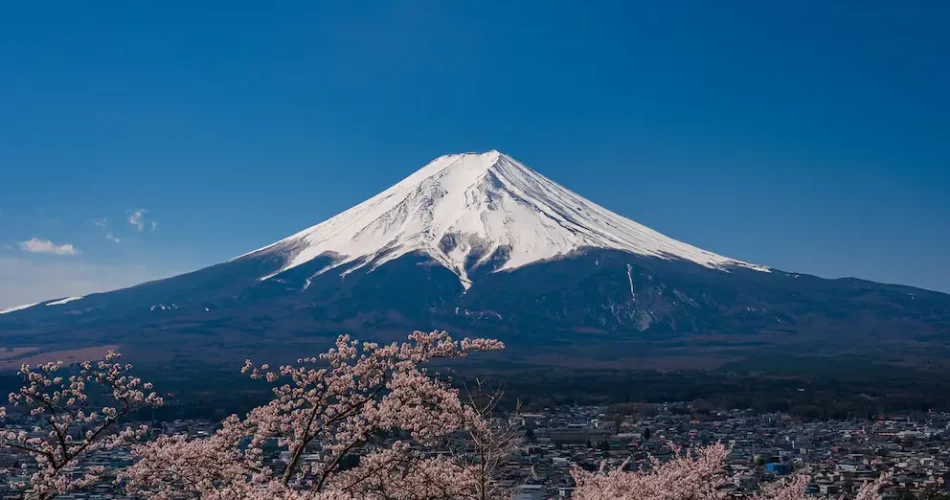
Mount Fuji is once again in the headlines, this time for a troubling family incident. A man was reprimanded by police after leaving his 7-year-old son alone for hours on the climbing route in fog and rain above 2,000 meters. The episode has drawn fresh attention to Japan’s highest and most iconic mountain — a place of deep spiritual meaning that also draws hundreds of thousands of visitors every summer.
Rising 3,776 meters between the prefectures of Shizuoka and Yamanashi, west of Tokyo, Mount Fuji remains an active volcano. Its last major eruption occurred between 1707 and 1708. Yet its near-perfect cone shape has made it one of the most recognizable images of Japan for centuries.
A Mountain of Pilgrims and Tourists
Long before it became a popular hiking destination, Fuji held sacred status in Japanese culture. In Shinto tradition it is linked to the deity Konohanasakuya-hime and the network of Sengen shrines at its base. For centuries people made pilgrimages there for spiritual discipline and purification. During the Edo period the Fuji-ko movement organized group pilgrimages that further strengthened its religious role.
Today the mountain attracts between 200,000 and 300,000 visitors each summer, according to the Japan National Tourism Organization. Many start from the fifth station on routes such as Fujinomiya, the path involved in the recent incident. From there the climb to the summit takes about five hours, with the descent requiring another three. Changing weather, altitude, and physical demand make preparation essential.
The surge in numbers has forced new rules. Some trails now have daily visitor limits and entrance fees designed to ease overcrowding and improve safety. Authorities continue to balance access with the need to protect both climbers and the mountain itself.
Beauty That Reaches Beyond Japan
Fuji’s cultural power extends far beyond its slopes. The UNESCO World Heritage listing in 2013 recognized its importance in Japanese art and identity, especially through the famous woodblock prints of Hokusai and Hiroshige. Its surroundings add to the appeal: the Five Lakes of Fuji, dense forests including Aokigahara, caves formed by ancient lava flows, and nearby hot springs. Lake Kawaguchi remains one of the most popular spots for viewing and photographing the peak.
Geologically the mountain is a stratovolcano that began forming roughly 100,000 years ago. Although it has stayed quiet for more than three centuries, scientists still classify it as active because of the region’s seismic activity.
A Place of Wonder and Responsibility
The recent incident serves as a reminder that Mount Fuji is not a casual outing. Its beauty and spiritual weight draw people from around the world, yet the same altitude, weather, and crowds that create unforgettable experiences also demand respect and caution.
For many visitors the mountain represents far more than a summit to conquer. It remains a living symbol of Japan — sacred, visually striking, and still capable of surprising those who climb it. As summer seasons grow busier, the challenge is clear: how to protect both the people who come and the mountain they come to see.