
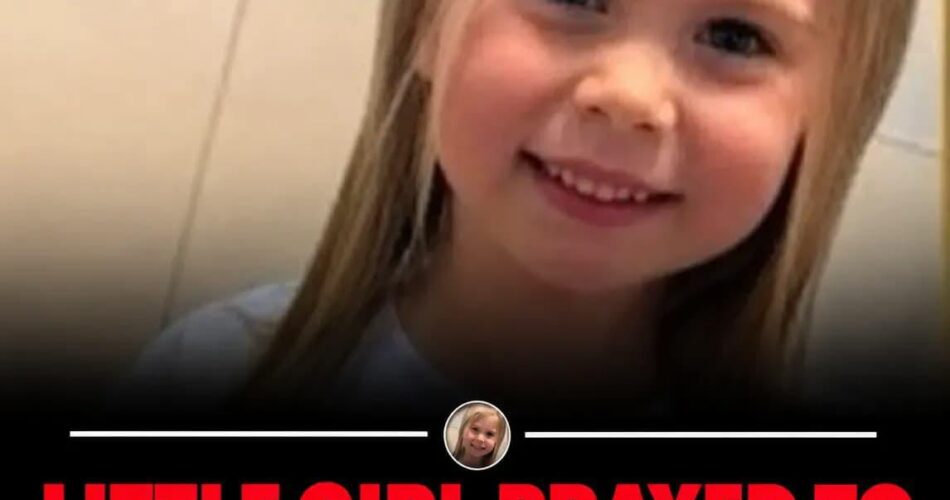
PHOENIX — Operating Room 4 was prepped and waiting. The IV lines were flushed, the surgical trays were laid out with sterile precision, and the anesthesiologist was ready to put 7-year-old Lily Harper to sleep for the fight of her life.
But before the medicine could take hold, the second-grader from a quiet Phoenix suburb had a final request. She wanted to pray.
What happened over the next few hours has left a family praising God and a team of seasoned medical professionals at Desert Valley Pediatric Medical Center scratching their heads.
In a case that bridges the gap between cold, hard medical science and the unexplainable nature of faith, a deadly brain tumor vanished completely—right before the surgeon’s scalpel could even touch her.
A Devastating Diagnosis
To understand the magnitude of what happened that Saturday morning, you have to go back to early September. Lily was a typical, high-energy kid whose life revolved around her local youth soccer league and playing with her golden retriever. But when she started stumbling on the field and waking up with blinding headaches, her parents, Mark and Sarah, knew something was wrong.
A trip to their pediatrician led to a referral for a neurologist, which led to a stat MRI. The results were every parent’s worst nightmare.
“They found a mass about the size of a golf ball,” said Mark Harper, sitting in his living room six months later, still shaking his head at the memory. “The doctors told us it was pressing right against her brainstem. The world just stops when someone tells you that about your little girl. You can’t breathe.”
The clinical diagnosis was a juvenile pilocytic astrocytoma. While often benign, the tumor was growing at an alarming rate. Because of its precarious location—nestled against the part of the brain that controls basic life functions like breathing and heart rate—the threat was immediate.
Dr. Aris Thorne, the hospital’s lead pediatric neurosurgeon, took the case.
“Surgery in this specific region is highly delicate,” Dr. Thorne explained in a recent interview. “You are navigating around the core wiring of the human body. The risks were immense—paralysis, severe nerve damage, months of rehab. But given how aggressive the growth was on the scans, we had no choice. It was a race against time.”
The Final Request
The operation was scheduled just twelve days after the diagnosis. During that agonizing waiting period, the Harpers, who are devout Christians, leaned heavily into their faith. Their local church organized prayer vigils, and a 24-hour prayer chain was set up by friends and family across the country.
But the hospital staff was most struck by the quiet faith of the 7-year-old patient herself.
On the morning of the surgery, the pre-op holding area was thick with tension. Sarah Harper was in tears, gripping her daughter’s hand, terrified it might be the last time she spoke to her awake. Mark stood silently by the bed, trying to hold it together. The surgical team bustled around them, running through the final checklists.
Then, Lily asked if she could pray.
Elena Rostova, the attending pre-op nurse, remembers the moment vividly. “You see a lot of heartbreaking, emotional things before pediatric surgeries,” Rostova said. “But when she asked to pray, the whole room just went completely still. It wasn’t a scared prayer. It was just a conversation.”
With her eyes closed and her hands folded over her faded hospital gown, Lily spoke out loud. She asked Jesus to guide Dr. Thorne’s hands. She asked Him to make her mom and dad stop crying. And finally, she asked Him to “please heal my head so I can go back to playing soccer.”
Moments later, the anesthesia was administered, and Lily was wheeled away.
An Unexplainable Scan
At Desert Valley Pediatric, standard protocol for complex brain surgeries requires a high-resolution intraoperative MRI (iMRI) right before the first incision. The brain can shift slightly inside the skull, and surgeons need the exact, real-time coordinates of the tumor to avoid damaging healthy tissue.
Dr. Thorne was scrubbed in, waiting at the monitors for the imaging technician to pull up the fresh scans.
When the images flashed onto the screen, the room went dead silent for the second time that morning. The massive, golf-ball-sized tumor that had been clearly documented on multiple scans just days earlier was gone.
“My first thought was that the machine was broken,” Dr. Thorne admitted with a laugh, though he noted he wasn’t laughing at the time. “I told the tech to recalibrate the iMRI and run the scan again. We checked the positioning. We checked everything.”
The second scan showed the exact same thing: nothing. Where a dense, life-threatening mass had been pressing into Lily’s brainstem, there was now only healthy neurological tissue. There was a faint shadow of necrotic (dead) tissue—essentially a microscopic scar—but the tumor itself had completely vanished.
“Tumors like this don’t just melt away overnight,” Dr. Thorne said. “From a purely scientific standpoint, it’s baffling. We look for biological mechanisms—maybe an incredibly rare immune system response where the body suddenly recognizes the tumor and destroys it rapidly. But to see a complete absence of a mass that size on the actual day of surgery? I’ve been cutting into brains for 15 years, and I’ve never seen anything like it.”
Science Meets the Miraculous
Faced with nothing to operate on, Dr. Thorne canceled the procedure. Lily was taken off the anesthesia and wheeled into a recovery room.
When she woke up, groggy and confused, her first complaint was that she was hungry. She famously demanded a stack of chocolate chip pancakes.
Meanwhile, Dr. Thorne had the unenviable task of walking into a waiting room to tell a terrified mother and father that he didn’t do the surgery.
“We were bracing for the absolute worst,” Mark recalled. “Dr. Thorne walked in looking like he’d just seen a ghost. When he told us the scans were clear and the tumor was just gone… we collapsed. We just cried and thanked God.”
In the medical community, cases like Lily’s are incredibly rare, documented under the clinical term “spontaneous regression.” Oncologists note that a few dozen of these anomalies happen globally each year, usually attributed to a sudden, hyper-aggressive immune response.
But for the Harper family, the medical terminology is just a scientific label for a miracle.
“The doctors were incredible, and science is a wonderful thing,” Sarah Harper said. “They call it a spontaneous regression. We call it an answered prayer.”
Back on the Field
Today, six months later, Lily remains completely healthy. Her follow-up MRIs have shown absolutely no signs of the tumor returning. Her motor skills are perfect, her headaches are gone, and true to her word, she’s back on the soccer field, running faster than ever.
Her story is still a frequent topic of conversation in the breakrooms at Desert Valley Pediatric Medical Center. It stands as a lingering reminder that no matter how much we understand about the intricate biology of the human body, there are still some things that simply defy explanation.
Whether it was a one-in-a-billion immune system response or the hand of a higher power stepping into Operating Room 4, the undeniable fact remains: a little girl prayed for her life, and today, she is healed.