
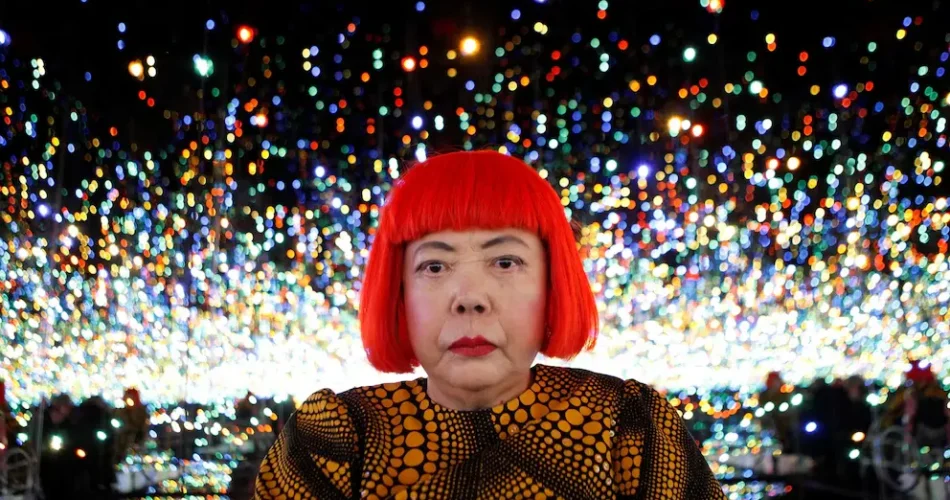
Yayoi Kusama, the Japanese artist who turned simple polka dots into a powerful visual language, has died at the age of 97. Her studio announced the news on Thursday, confirming she passed away on August 14 in a Tokyo hospital.
Known worldwide as the “Queen of Polka Dots,” Kusama spent a lifetime exploring infinity, repetition, and the boundaries of the self through painting, sculpture, installations, performance, and writing. Her company described her as a pioneering avant-garde artist who lived an “extraordinary life completely dedicated to artistic creation.” She continued painting until her final days, never putting down the brush.
A Vision That Began in Childhood
Born in 1929 as the youngest daughter of a wealthy Japanese family, Kusama began developing her distinctive style around age 10. As a child she experienced vivid hallucinations — one famous memory involved a red floral pattern on a tablecloth that seemed to spread across the ceiling, walls, and even her own body. Those early visions became the foundation of her art.
She built a visual language of dots, nets, and obsessive repetition that she called “self-obliteration.” The goal was to dissolve the individual into a larger, infinite pattern. That idea would shape decades of work.
From Japan to New York and Back
After studying art in Japan, Kusama moved to the United States in the late 1950s and became part of New York’s avant-garde scene. She gained attention with large-scale paintings and bold performances that challenged the art world’s norms. As a Japanese woman working in a male-dominated American scene, she faced discrimination, yet she pushed forward with provocative “happenings” that used body paint and polka dots.
In the early 1970s she returned to Japan and later chose to live in a psychiatric hospital in Tokyo. From there she continued creating without interruption, turning personal struggle into sustained artistic output.
Works That Captured the World
Kusama’s most famous pieces include her pumpkin sculptures, immersive Infinity Rooms filled with mirrors and lights, and installations that make viewers feel surrounded by endless patterns. One of her pumpkins stands on the art-filled island of Naoshima in Japan. Her works have sold for millions of dollars and appear in major museums around the globe.
She also created a fashion line, founded a “Church of Self-Obliteration,” and once performed as the “High Priestess of Polka Dots” at a same-sex wedding. Her bright red wig and polka-dot clothing became as recognizable as her art itself.
A Lasting Legacy
Tributes poured in after the announcement. Many remembered not only the boldness of her work but also the sense of wonder it created. One Japanese admirer wrote that her paintings felt “bold, delicate, and beautiful” and that she herself was “truly endearing.”
Kusama leaves behind a body of work that continues to invite people to lose themselves in color, pattern, and infinite space. Even in death, the dots she spent a lifetime painting keep expanding.