
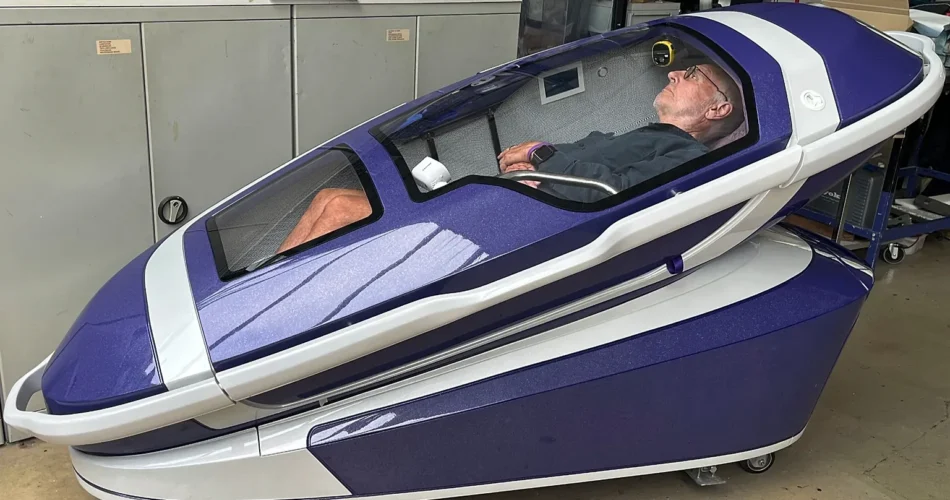
A man who made a controversial “suicide pod” now says AI should take over big decisions about who can end their life. Philip Nitschke, the Australian doctor behind the Sarco capsule, thinks computers could do a better job than psychiatrists at checking if someone is mentally ready for assisted death. His words are sparking strong feelings and big debates right now.
Nitschke has fought for the right to die for over 30 years. He started Exit International, a group that helps people end their lives on their own terms. Back in the 1990s, he was the first doctor to legally help a terminally ill man die in Australia using a special machine. That law got changed later, but it pushed him to say death should be a personal choice, not something doctors control.
His latest invention is the Sarco—a 3D-printed capsule that looks like a small spaceship. A person lies inside, presses a button, and nitrogen gas fills the space. They fall asleep fast and pass away peacefully in minutes. It’s meant to feel like going on a trip, not something scary. The pod costs around $15,000 to make and anyone can print it if they have the plans.
The first person used a Sarco in Switzerland in September 2024. It caused huge upset. Police arrested people involved, seized the device, and started legal cases for helping with suicide. Swiss law allows assisted dying in some cases, but they said the pod broke rules. One man who helped got released but later chose assisted death in Germany in 2025. Nitschke is already working on a new version, even one big enough for two people to die together.
Now he wants AI in the mix. In places where assisted dying is legal, psychiatrists usually talk to people to see if they understand their choice and are not depressed. Nitschke says this doesn’t always work well. Different doctors can give different answers about the same person. He wants an AI avatar instead. You chat with it about your reasons. If the AI says you have mental capacity, the pod opens for 24 hours. You can change your mind in that time. If not, you talk again.
He admits AI has biases, but he thinks it can be fixed better than human doctors, who bring their own ideas. “If you’re an adult with mental capacity and want to die, you should have the right to a peaceful end,” he says.
Not everyone agrees. Many psychiatrists think it’s a bad idea. One expert from AlgorithmWatch says tech is never neutral—it comes from people and can carry old biases or unfairness. Trusting AI for life-and-death calls could hurt autonomy instead of help it. There are worries about mistakes, like confusing real pain with a clear choice. Cases where people talked to chatbots about suicide make folks nervous too.
This talk comes as assisted dying rules change in more places. Nitschke wants to take doctors out as “gatekeepers.” He sees AI as fairer and more private. But critics fear it opens the door to abuse or bad decisions for vulnerable people.
The Sarco story already made headlines around the world. Adding AI makes it even hotter. It forces us to ask tough questions: Who decides when life ends? Can a machine really understand a person’s mind? And should death stay human, or is tech the way forward?
Nitschke keeps pushing. For him, it’s about freedom and dignity. For others, it’s a scary step into unknown territory. This debate is far from over, and people everywhere are watching closely.